Sunday, January 16, 2022

4th Congress, Bucharest 1971

 Reposted from 4th International Congress, Bucharest 1971 


I have never been to Romania. I was even unsure whether the country was called Romania, Roumania or Rumania. (I have now learned that since 1975 it is Romania).

I had only known about Dracula and Transylvania and  Nicolae and Elena Ceaușescu's execution, as dreadful grainy pictures in old newspapers. So I was in a bit of a bind to tell a story about this congress, as I have been writing about others.

Of course the hard information about the Congress is  available. Most of the program committee consists  of very well known logicians: P. Suppes (Chairman), A. Mostowski, A.A. Markov, M. Rabin, G. Kreisel, W. Stegmüller, K. J. J. Hintikka, A. Grünbaum, M. O. Beckner, A. N. Leontiev, P. Lazarsfeld, S. Marcus,  and M. Hesse as Section Chairmen. This way I 'discovered' the work of Mary Hasse and you should too.

I also read about the Romanian Organizing Committee: A. Joja, G. Moisil, C. Popovici (General Secretary) and wondered about how close this congress was of the taking of power by Ceaușescu. I read most about Moisil, because I like algebraic logic. But this is not a sensible blog post material here. 

So I ended up looking up the President of the Executive Committee of the Congress, Stephan Körner, The University of Bristol BS8 IRJ, England. I learned that he was the father of Tom Korner, who was one of my professors in  the Cambridge Part III course. Tom was an extremely nice professor, not only to me, but to generations of Part III students. His website gives a glimpse of his kind of self-deprecating humour, which I always enjoyed, once I was able to understand it.

Tom has some advice for people taking Part III in his website. This brought back loads of memories of my year doing Part III in Cambridge: it definitely was the hardest course I've done in my life, by a very long stretch. So it's kind of comforting that much more accomplished people than me also say so. 

Reading his advice I was reminded of a story from when I first started in Cambridge. I could read English well and I could take exams fairly well (I was accepted in most of the Mathematics departments I applied to do my Phd), but I had been thinking of going to France, where I knew a professor doing categorical model theory. Hence my spoken English was terrible and my understanding of spoken English was even worse. For a few weeks in the beginning of Part III lectures, the abbreviation (TFAE = the following are equivalent) was written in the huge blackboards
of the Mill Lane Lecture rooms over and over. Little me assumed that the letters where the initials of some very famous mathematicians, so I kept thinking to myself, these guys, who are they? They're everywhere, even more than Gauss? How come I never heard of them? Eventually the penny dropped, but I think this shows how hard that first year was.


1st International Congress, Stanford 1960


Benedikt Loewe has done a great job of finding all the official information about the DLMPS congresses. And if you're only interested in the hard, concrete facts you can make your way to  the page of Past Congresses and be done. My intention here  is to discuss the fluffy side of some of the meetings, just for fun.

The first meeting at all was the

1st International Congress of the Division of Logic, Methodology and Philosophy of Science, Stanford University 1960

Now the Dept of Philosophy of Stanford has a nice history where we can read about the Suppes era, when the first congress happened. They say: 

Suppes’ indelible presence in the Department spanned sixty-four years (42 years on the full-time faculty, after which he remained deeply engaged as Emeritus Professor until his recent death in 2014). His foundational work across numerous fields in philosophy and in the sciences earned him many honors, including membership in the National Academy of Sciences, the National Medal of Science, and the Lakatos Award. 

First I thought my fluffy story about this conference would be the "mystery" in the preface where the editors say: Due to unforeseen circumstances, Professor Nagel was forced to resign as Chairman of the Organizing Committee just prior to the opening of the Congress, and Professor Tarski served in that capacity during its sessions.

This is good, we can conjure up a whole murder mystery on that "forced to resign", right?

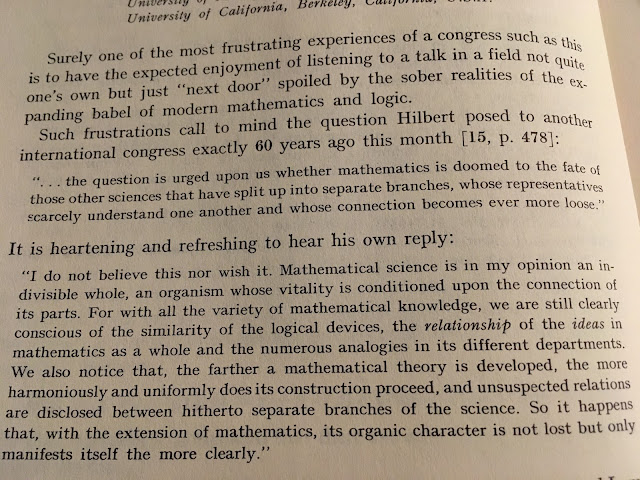
But then looking at some of the papers (the book with only invited papers has 672 pages!) I discovered something much fluffier. For me at least. Here it is:

This is J. W. Addison talking about the "expanding babel of modern mathematics and logic". And bringing Hilbert into the picture to explain that Mathematics is an indivisible whole, a connected organism that as farther as it's developed, the more we can see the harmony between its parts. 

This is pink-unicorn kind of fluffy, as far as I'm concerned!


Congresses of the Division of Logic, methodology and philosophy of science and technology


The series of Congress of Logic Methodology and Philosophy of Science (since 2019 CLMPST; Congresses for Logic, Methodology and Philosophy of Science and Technology) are the quadriennial main event of

The next one will be held in July 2023 in Buenos Aires: clmpst2023.dc.uba.ar.

But there were 16 so far. So a small project of the Women in Logic network was created to read about these congresses and describe a little how logic and logicians have been interacting since the first one, in Stanford in 1960. 

I've asked for help writing small blog posts about the congresses, but  this was  a bit late and so not all the blog posts have been written, yet. But I will copy and reproduce here the ones that have been done.

Like everything else this blog is a work in progress!

World Logic Day 2022


Since 2019 the World Logic Day is celebrated on January 14th. So it's not an old tradition, but it's one that speaks to many logicians, who would like the work they do to be better known and appreciated. So the number of seminars, small conferences and round tables have been mushrooming, which is great!

But if one has so many meetings to go to and they are not recorded, they only give you a nasty feeling of "missing out": even in the pandemic, even when the meetings are free and in principle accessible you are not able to watch them all, to take it all in--of course one needs to think how accessible things are at 5 am-- and this is bad. Or feels bad. So I thought I would like to do something different for World Logic Day 2022.

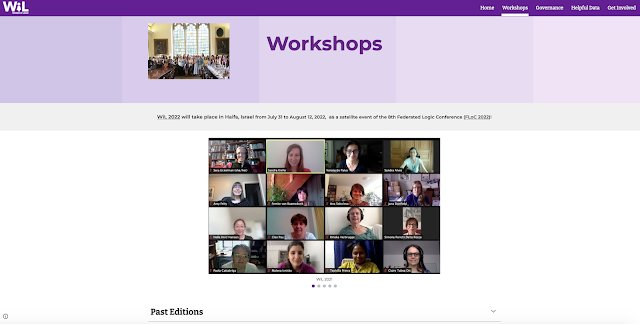
It occurred to me that instead of a meeting we should celebrate by having the launching of the Women in Logic website (https://sites.google.com/view/womeninlogic/home) this World Logic Day. We did a soft launch a week before (i.e Friday 8th) and tried to iron some of the issues, but some remained. Bugs in life and software are always there.

I'm really impressed with the website which is mostly the work of Juliet Szatko and Sandra Alves. It's beautiful, it contains lots of information about the work we've been doing in the WiL workshops, the facebook group, the twitter account, the slack channel, etc. It also points out the many projects that we are trying to do, but haven't got finished, yet. One of these small projects is described in the next blog posts, check it out!

 Many thanks for this exquisite gift, Juliet and Sandra!

Saturday, July 31, 2021

Women in Logic 2021


(This is copied from Logic ForAll, where it appeared in June 2021)

We just had another great edition of Women in Logic! Congrats to the organizers Sandra Alves, Sandra Kiefer and Ana Sokolova for a fun, challenging and  diverse meeting! Thanks also to our Invited Speakers Professors Simona Ronchi Della Rocca (Università di Torino) and Rineke Verbrugge (University of Groningen) for very inspiring talks!

This time we didn't have any incidents like last year (my write-up of the incident last year is in The curious incident of the dropped streaming, if you want to see it), but on the other hand we didn't have the streaming either and this is not so good. 

We are a small workshop, so we follow what the conference we're associating with says; and I think it's fair to say that the main issue this year has been the registration fee, which was plainly terrible. This came as a surprise to me (and, I believe, to everyone else too!). Since last year there was no registration fee for the workshop, I thought this year was going  be the same. After all,  our workshop is about logic work done by women, but it is not exactly a huge source of brownie points (or commercial value) to anyone. We help people get used to presenting their work, in other more 'hostile' environments, and I have been extremely impressed with the quality of the work the young ones do. They get some amount of mentoring on their papers and on dealing with questions, misunderstandings, etc. But for the audience, which is there to cheer them on and to learn a few things about their work, to pay 30 euros for a single day seems excessively expensive! 

After all, the silver lining of the pandemic and of the lockdowns had been the possibility,  for many, to interact with their academic heroes, to watch seminars that happened in all parts of the world, "to be" in Australia one day and the next in Colombia, while still hearing about your favorite subject. That now people insist on gatekeeping these possibilities, by making the conferences unaffordable, seems perverse.

I understand that even online conferences have costs that need to be paid, but I worry that calculations and sponsorships are following outdated models. And I believe the push to make it more accessible needs to be done by everyone in the community, not just a few. Otherwise, the prestigious conferences will carry on being unaffordable, reproducing the sins of the conventional publication model.

Thursday, March 4, 2021

Think women discrimination is a thing of the past?


Think again. This story came from one of my friends, who teaches in a local community college. My friend's daughter is a sophomore at a research university. She came up with an idea for a project in one of her neuroscience classes, developed her idea with a female friend, and they spent hours explaining the idea to the guys in the group. 

When the time came to present the project to the class, the guys questioned their ability to present and asked her to present to them first so they could be assured she was prepared and knew what she was talking about. So they  basically questioned her understanding of her own idea.

This is 2021!


Sunday, February 21, 2021

Woohoo, you and the husband are invited to a prestigious research centre?

 This is one of the histories that has a kind of happy ending, but only kind of as it seems that the scientific research center policies are still in flux. Judge for yourself.  My job is just to collect the histories, with or without name, as  people prefer it.

This story is described by an open letter in Prof Agricola's website. Professor Agricola is now President of the German Mathematics Association (DMV) and her mathematical career is not in danger.  She has the following Open Letter on her website https://www.mathematik.uni-marburg.de/~agricola/ewm-open-letter.html. I will copy  it below, but you should read it in the link, where you can find this picture.

This is Prof Agricola's son, aged three months, sleeping in the desk, while she does maths with her students. Sweet! Now you may think 2014 in Prof Agricola's letter and think this is pre-historic (some people do!), but then you should check Viviane Pons blog post from 2019 http://openpyviv.com/2019/06/08/baby-vs-cirm/, which is again a similar story.

Just one extract from Pons' blog post, that again is better written than I can provide and very much worth your time reading:

"But things changed. They changed because women and allies did not give up. There were some open letters and petitions circulating. There were some pressure being made. At a time where supporting women in math was becoming “trendy”, the policy started to be bad publicity. When CIRM would brag about their actions for supporting women (like women speaker requirements, women events, etc), there would be people to remind them of their policy. I actually know one of these women. She is a senior researcher very much involved in defending women in mathematics globally. Once at a board meeting for conference centers, she did say to them: “these things are nice of course, but what about accepting children and nursing mothers inside your facility? This is your biggest issue!”. She told me the answer she got from the CIRM at the time was along the line of “What? This has nothing to do with that! This is a legal issue we cannot do anything about”. Well, they could, and at some point, they did."

For me, my first child also went to her first conference when she was three months old.  And we cooked dinner for something like fifteen people during the meeting together. We had babysitters that we took with us to funny places, we did the old routine of "I just talked, give me the baby so that you can go talk" (when both of us were teaching), I gave talks holding on to the baby and pacing up and down to make her go back to sleep, etc. I like what I do and I wasn't going to let my children stop me from doing it.

What makes me tired is that we write letters, complain, organize petitions and we win some. But then the next week, the month or the next year, we're back at square one. It can be really tiring sometimes.

======================

Prof Ilka Agricola's letter

Dear Colleagues,

in October 2014, I was invited to attend a Meeting at CIRM in Marseille, the "Centre international de rencontres mathematiques", a conference center devoted to mathematics.

My first visit to the CIRM was as a Ph.D. student - I was single, no kids. I enjoyed my stay very much, the atmosphere for exchange and research, the beautiful surroundings. So I was looking forward for visiting the CIRM again.

However, this was not possible. My personal situation has since then changed: I am married, and we have an 11 year old son. My husband is a professor of mathematics as well, working in the same area. So in fact, I have to correct my statement: We were both invited by the organizers to be regular participants of this meeting. We therefore informed the organizers and the CIRM that we would like to bring our son. Of course, we would pay his expenses and organize a "baby sitter" for him, so that he would be occupied during the day.

Our son attended his first conference when he was 3 weeks old. Whenever possible, we leave him at home with suitable child care. But as most scientists, we do not have any relatives in the city where we were appointed professors, so it's not always possible. Our son has accompanied us to research stays all over Europe, South America and Asia. We're great at finding baby sitters wherever we go. We never had any problems, our son was welcome wherever we went. It's clear that we organized things always in such a way that he would not be a burden to organizers or other participants.

But at CIRM, all my past experience in organizing two professors and a kid was useless. I was informed sharp by the CIRM administration:

"For security reasons, children are not admitted at CIRM".

I first thought that this was a joke - our son is not dangerous, after all? But it became clear that this is dead serious. It is claimed that the insurance of CIRM "does not cover children", whatever it means. Now, being German, I have more insurances than I would ever need in my life: liability insurance, accident insurance... you name it. I offered to sign anything desired that I would cover all damages my son would cause. Nothing to do.

Instead, the CIRM administration started an outrageous game of shifting duties - weeks, almost months of e-mail exchanges followed. For example, we were told that we should try to find accomodation at the "Cite Universitaire" of the University of Marseille. Guess what they told us ? "We regret that our housing is not appropriate for families". More phone calls, more e-mails - to organizers, CIRM staff, CIRM director etc.

Finally, we gave up and cancelled our participation. And I sent a complaint to the "conseil scientifique de l'Institut National de maths du CNRS", who is part of the scientific committees supervising the CIRM. And, all of a sudden, we were offered to live at CIRM in a separate building. However, our son was still not allowed to enter the CIRM or to have breakfast and dinner there. But then we didn't want to go anymore.

Now, I understand that in the past, people may have abused of the CIRM facilities to have a nice holiday with their families - allegedly, I would think that these would have been male participants bringing their wife and children.

But our situation was different. Being both scientists in the same area, our only option for participating was to travel with our son. It is to be expected that this constellation will be even more common in the future, with more and more women in mathematics. Other situations can easily be imagined where there is just no alternative to bringing a child - a baby being breast-fed, an ill child, a single parent...

So, for me the current CIRM policy means effectively that I am being hindered to "practise" my job as scientist. And this is something that we, female mathematicians, should not accept. It is not a solution that perhaps, once in a while, one of us is successful at making enough ruckus to get an exceptional permission to bring a child - a Ph.D. student or less pushy person would not have succeeded. The policy itself NEEDS to be changed!!!

I am full professor now, I do not need to attend some singular event - if I'm not wanted, I don't go, period. But if I had never been allowed to bring my son anywhere - I would probably not be full professor today!

I firmly describe myself as being "francophile" - I attended a French Lycée in Munich, I have a French Baccalauréat C (high school degree) and even was hounored by a second price at the Concours Général des Lycées. I have some experience with French administration. Hence, this experience really makes me very sad.

I believe that French women mathematicians should urgently advocate a change in policy at CIRM. I would consider it bad style to do this as a foreigner - so, I hereby would like to encourage YOU, mathématiciennes françaises, to fight for working conditions that respect the situation of women in science! Our daily juggling of different responsibilities is already difficult, there is no need to make it harder by rules that are not up to date.

In the meantime, we were both invited to another CIRM meeting. We declined immediatly, it doesn't make sense to repeat the same story over again. Again, I would very much have liked to attend this "rencontre" and meet my colleagues. This shows that the problem will stay if nothing is being changed!

With my warmest regards from Marburg,

cordialement

Ilka Agricola