Wednesday, July 23, 2025

Against Manels


 Women in Logic 2025, Birmingham, UK

Dear me! I knew I was slow at writing on the blog, but I didn't realize I was this bad.

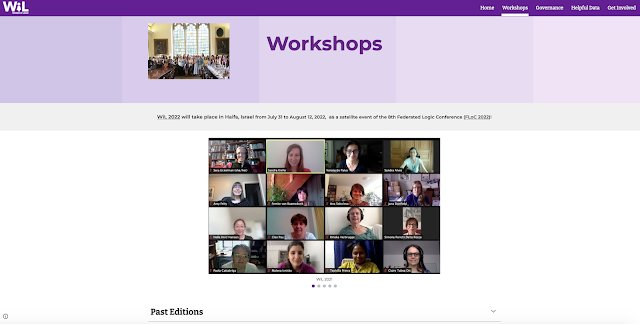
Three years have gone by since the last post. Thank goodness other people have been doing better and we had WiL 2023, WiL2024 and WiL2025 all beautifully done. The picture above is from WiL 2025 in Birmingham,  2025. Anela Lolić in the picture below, chaired the proceedings. Thank you Anela, Elaine and Tephilla for the organization of WiL2025! Thank you Daniele Nantes and Liron Cohen for being our Invited Speakers!

But the reason for this post is not to celebrate WiL2025 (maybe it should be!) but to provide a template complaint letter about Manels, written with the help of chatGPT. 

There have been several series of emails/messages/texts with one or another of us complaining about manels in Logic. We discuss it, we get frustrated, we write to the people concerned and mostly  we just feel that nothing good is ever happening. Of course loads of regressive steps happened recently, but we need to carry on trying to make things better for all. So here is a template--at least it saves time. Please let me know of others and of improvements.

 ----------------------- 

UPDATE: a slightly improved and modifiable version can be found at this google doc.

Subject: Lack of Gender Diversity in [Conference Name]

Dear [Organizers/Conference Committee],

I am writing to express my concern about the lack of gender diversity in the organization and speaker lineup of [Conference Name]. The absence of women and other underrepresented groups—whether among invited speakers, tutorial presenters, panelists, session chairs, or organizers—sends a troubling message about who is considered central to the field and whose expertise is valued.

This is not just a matter of optics or tokenism. Numerous studies have shown that diverse groups produce better, more innovative research outcomes. For example, research published in Nature Human Behaviour (Nittrouer et al., 2018) found that the prevalence of all-male panels (or “manels”) is statistically unjustifiable given the number of qualified women in science. In computing, mathematics, and many adjacent disciplines, the percentage of women with advanced degrees and notable contributions is sufficient that an all-male lineup is rarely, if ever, a result of chance—it is a reflection of biased selection processes, however unintentional.

A conference that fails to include women and underrepresented groups in visible, authoritative roles not only excludes valuable perspectives—it also perpetuates structural inequalities in academia and industry. Moreover, it sends a disheartening signal to junior scholars from underrepresented groups that their participation is neither welcomed nor expected.

I urge you to take concrete steps to ensure greater inclusivity and equity in future events. This includes, but is not limited to:

  • Actively seeking out qualified women and gender-diverse experts for keynote, tutorial, and panel roles.

  • Making the selection process transparent and accountable.

  • Engaging with diversity guidelines and pledges (e.g., the “No Manels” pledge many scholars have adopted).

  • Including diversity goals as a criterion in funding and sponsorship decisions.

I appreciate the effort that goes into organizing academic events, and I am confident that more equitable and inclusive planning is both achievable and necessary. I hope to see future iterations of [Conference Name] reflect the full breadth and richness of our field.

Sincerely,
[Your Name]
[Your Affiliation, if applicable]
[Optional: Contact Information]


(Could be send in name of a group like Women in Logic too!)


Monday, October 10, 2022

Women in Logic 2022


Our workshop Women in Logic (WiL) 2022 at FLoC (Federated Logic Conference) in Haifa, Israel was a big success. This was the first time ever that I was not present at Women in Logic, and I confess that it felt very strange (and sad) not to be there. 
 
This was the 6th year of the workshop and I had promised myself that I was going to do three workshops and hopefully by then the workshop would be established, and I could withdraw gracefully. I was not counting on the COVID pandemic, when I made these optimistic plans. And in any case, three years is not nearly enough to really establish something like a workshop that you only want to stop doing when there is gender equality in our community.
 
But sure enough, the workshop is very much established by now.  I am extremely grateful to all, for the collective effort that it has taken. The organizers this year (Sandra Alves, Sandra Kiefer and Daniele Nantes) and the previous years' organizers have been wonderful, and I'm sure will continue to do a fantastic work. Our community is growing--slowly, but surely. Our Steering Committee has been consolidated, following the "by laws" decided earlier on. This year in March we launched the Women in Logic website. We keep inventing new ways of fighting gender discrimination and also new ways of having some fun, while doing it.

In July, the WiL workshop at FLoC had the biggest number of registered participants in all FSCD workshops. As usual we had two invited speakers: Dana Fisman (Ben-Gurion University of the Negev) 
and Delia Kesner (Universite Paris Cite and Institut Universitaire de France). 
We also had nine contributed talks (you can find titles and abstracts in the program).  
And all presenters were live in Haifa, as Amy Felty remarked.
 We also had a special dinner, actually the dinner was for all women at FLoC, not only the ones at WiL, where the photo above was taken. WiL was asked to organize The first Women@FLoC dinner, supported by both Microsoft
 and FLoC. We want to thank very much Nikolaj Bjorner from Microsoft Research,
 who helped to set this support for us!
 
The dinner was opened by Alexandra Silva (FLoC general chair), followed by a short Q&A 
with three women representatives of different areas of FLoC:  
Ilina Stoilkovska (researcher, PrimeVideo), Norine Coenen (Ph.D. student,  CISPA 
Helmholtz Center for Information Security),  and Amal Ahmed 
(Professor, Northeastern University). 
We thank all of them for helping us make clear that theoretical computer science 
also needs gender equality and parity. The science is uncontroversial:  diversity 
and inclusion make science, academia and industry better, measurably so.
 
Sandra Kiefer, a joint organizer of the last three Women in Logic workshops, 
was invited to give a talk about "Women in Logic" in the Diversity & Inclusion session 
at the 19th International Conference on Principles of Knowledge Representation and
 Reasoning (KR2022). More details about the WiL meeting will appear soon in the report 
produced by the organizers, Sandra Alves, Sandra Kiefer and Daniele Nantes.
 
Join me in thanking them for the hard work they put into making our workshop a reality! 
 
 And yes, stay tuned for the Women in Logic 2023!

Sunday, March 20, 2022

Carol Blasio Day: Diversity in Logic


Celebrating life and publicizing the legacy of women who, no longer transiting among us, remain vivid as inspirations in our memories and actions is a way of resisting the discouragements of these times – which we can barely describe without disturbing our hopes.


On the 20th of March, by the ruler of the Gregorian calendar, Carolina Blasio a young and talented feminist Brazilian philosopher and logician – would be commencing another life cycle. Astronomically, the date is also when the equinoxes occur, the days in which day and night, in symmetry, last practically the same time. In the South of the globe, the date marks the arrival of autumn light, in the North one celebrates the colors of spring.


To make Carolina Blasio’s trajectory known and to preserve her legacy for philosophy, for logic – but above all for people who dedicate their lives to these fields of knowledge and knew her – we chose March 20th as a symbol of her life, vivacity, and of the rarity of the philosopher, logician, teacher, friend, tutor, and mother – the woman who Carolina was. Although the event was imagined in 2020, only now have we been able to announce it and to invite friends, colleagues, and students whose memories attest to Carolina's importance as an example of integrity, brilliance, and generosity inside and outside the academic environment – to send short texts and videos associated with Carolina's intellectual interests and personality traits. This is the Carol Blasio Day for Diversity in Logic!


To the extent of our strengths and agendas, for this first edition, we also encourage among friends the holding of small events associated with the celebration. With these humble gestures, we are just beginning the propagation, beyond the circles frequented by Carol, of her multiple efforts in favor of more equity, diversity, and inclusion in Academia. Those efforts will not be forgotten, as they are already being transmuted into energy of action for more diversity in teaching, studying, and popularization practices of Logic in our country.


All tributes – reports, letters, notes, and other forms of written record sent to us (mainly in Portuguese) are available on our LBBlog. 


The video tributes are available on the  Brazilian Logic Society (SBL) YouTube channel.


In celebration of those who are gone (el Día de los Muertos), the Lógica MX collective posted a very informative thread on Carol's legacy (in English) on their Twitter account.


Finally, we list below some events and publications associated with the celebration of Carolina Blasio’s life and work.


Special Session of the UFBA Logic Seminar

Title: Dialectics and the Kolmogorov-Veloso Problems

Speaker: Valeria de Paiva (Topos Institute)

Day/time: Monday, March 21, 7:00 pm (Brasilia time)

Link: contact us logicasbrasileiras at gmail.com. (The talk will be held in Portuguese)


Carol’s paper: Revisiting the Dunn-Belnap logic, translated into English by Evelyn Erickson and revised by João Marcos.


A special volume of Synthese was dedicated to the memory of Carolina Blasio, Varieties of Entailment. We recall below the two first paragraphs of the introduction to this volume, written by Wansing and Ruffino (who was also Carol’s Ph.D.)


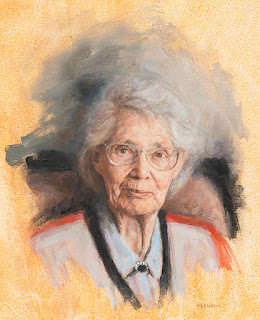
This special issue of Synthese is dedicated to the memory of Carolina Blasio da Silva, a young and talented Brazilian logician, who sadly left this world too early, only one day after successfully defending her Ph.D. thesis on non-classical forms of entailment at the University of Campinas, Brazil, on August 25, 2017. Carolina originally studied Psychology and Philosophy at the Federal University of Juiz de Fora, Brazil, and did her MSc on Heidegger and the question of time. She did part of her undergraduate studies in Passau, and spent time as a visiting researcher, during her graduation period, at Tel-Aviv University, King’s College London, Vienna University of Technology, the University of Lisbon, and Ruhr University Bochum. She was the administrator of the Brazilian discussion group on Logic, an active member of the Brazilian LaTeX community, and a feminist campaigner.


Before her untimely death, Carolina was working intensively on a many-dimensional notion of logical consequence and generalized logical values related to that conception. She did so not just in her dissertation, but also in several papers (some of them already published and some about to be submitted). For those who had the fortune to know her, it was at the same time lovely and inspiring to see Carolina being both an active young researcher and a caring mother in the many international conferences on logic and philosophy to which she brought her baby daughter. Carolina’s enthusiasm and intellectual love for her work were contagious, as was her sympathy, personal charisma, and generosity, and we are grateful for her legacy both as a philosopher and as a human being. She is survived by her logician husband, João Marcos, and their daughter, Maia.


Hopefully, Carol’s presence will thrive in our increasingly diverse academic practices in logic and philosophy. Happy new equinox!


(Guest post by Gisele Secco)


Lógicas Brasileiras/Brazilian Women Logicians

Logic and Philosophy are, still, two male-dominated fields. Nothing new under the sun. 


What is relatively new is the fact that over the last years, all over the world, women and the so-called minorities have been gathering, raising their voices at events, and publishing their complaints about gender disparity (and other ways in which diversity is lacking) in academic environments. We have been paying more and more attention to the nuanced ways through which misogyny, racism, and other discriminatory tendencies affect women in many contexts: research, transmission, and communication of logical knowledge. We have been registering data, elaborating claims and suggestions for transforming the logical landscape in all its disciplinary interfaces (with Computing, Philosophy, Mathematics, etc..), making its practice more attractive and welcoming for people who "normally" do not adapt to the often-harmful atmospheres in which logic is practiced. Everyone acquainted with the Women in Logic project can understand that we are just getting started.


In Brazil, where Logic is a subfield of Philosophy (at least from the point of view of the institutional taxonomy through which research is funded by public institutions), things do not differ much from what one could call “the average situation” with respect to disparities of gender, ethnicity, class, etc.. in logic as a field in rest of the world. In 2019, in a roundtable during 19th the Brazilian Logic Meeting, the “women problem” was officially assumed by the Brazilian Logic Society – nowadays presided by a woman. In tune with initiatives such as the WiL project (but also the Inclusive Logic Day, the Women in Machine Learning, the German-Speaking Women Logicians, among others), and taking into consideration the specifics of our context, in 2020 we launched the website Lógicas Brasileiras (Brazilian Women Logicians). 


Our central aim is to give visibility to the work of all Brazilian women involved with logic as researchers, professors, teachers and/or disseminators to broader audiences. We believe that this kind of initiative is crucial for encouraging more young people, especially women, to invest in their potential. It is essential to show them that they do not need to feel alone, that there is a community for all of us. 


Up to now, we have been interviewing women that do/teach/disseminate logic, gathering materials for historical research (such as this one) and participating in one or another event (like this).


Today March 20th we are celebrating Carol Blasio Day for Diversity in Logic,

about which you can read more in the Logicas Brasileiras post here.

Our communication is held mainly in Portuguese, but you can find some of our things in English here and here.


(Guest post by Gisele Secco)

Sunday, January 16, 2022

4th Congress, Bucharest 1971

 Reposted from 4th International Congress, Bucharest 1971 


I have never been to Romania. I was even unsure whether the country was called Romania, Roumania or Rumania. (I have now learned that since 1975 it is Romania).

I had only known about Dracula and Transylvania and  Nicolae and Elena Ceaușescu's execution, as dreadful grainy pictures in old newspapers. So I was in a bit of a bind to tell a story about this congress, as I have been writing about others.

Of course the hard information about the Congress is  available. Most of the program committee consists  of very well known logicians: P. Suppes (Chairman), A. Mostowski, A.A. Markov, M. Rabin, G. Kreisel, W. Stegmüller, K. J. J. Hintikka, A. Grünbaum, M. O. Beckner, A. N. Leontiev, P. Lazarsfeld, S. Marcus,  and M. Hesse as Section Chairmen. This way I 'discovered' the work of Mary Hasse and you should too.

I also read about the Romanian Organizing Committee: A. Joja, G. Moisil, C. Popovici (General Secretary) and wondered about how close this congress was of the taking of power by Ceaușescu. I read most about Moisil, because I like algebraic logic. But this is not a sensible blog post material here. 

So I ended up looking up the President of the Executive Committee of the Congress, Stephan Körner, The University of Bristol BS8 IRJ, England. I learned that he was the father of Tom Korner, who was one of my professors in  the Cambridge Part III course. Tom was an extremely nice professor, not only to me, but to generations of Part III students. His website gives a glimpse of his kind of self-deprecating humour, which I always enjoyed, once I was able to understand it.

Tom has some advice for people taking Part III in his website. This brought back loads of memories of my year doing Part III in Cambridge: it definitely was the hardest course I've done in my life, by a very long stretch. So it's kind of comforting that much more accomplished people than me also say so. 

Reading his advice I was reminded of a story from when I first started in Cambridge. I could read English well and I could take exams fairly well (I was accepted in most of the Mathematics departments I applied to do my Phd), but I had been thinking of going to France, where I knew a professor doing categorical model theory. Hence my spoken English was terrible and my understanding of spoken English was even worse. For a few weeks in the beginning of Part III lectures, the abbreviation (TFAE = the following are equivalent) was written in the huge blackboards
of the Mill Lane Lecture rooms over and over. Little me assumed that the letters where the initials of some very famous mathematicians, so I kept thinking to myself, these guys, who are they? They're everywhere, even more than Gauss? How come I never heard of them? Eventually the penny dropped, but I think this shows how hard that first year was.


1st International Congress, Stanford 1960


Benedikt Loewe has done a great job of finding all the official information about the DLMPS congresses. And if you're only interested in the hard, concrete facts you can make your way to  the page of Past Congresses and be done. My intention here  is to discuss the fluffy side of some of the meetings, just for fun.

The first meeting at all was the

1st International Congress of the Division of Logic, Methodology and Philosophy of Science, Stanford University 1960

Now the Dept of Philosophy of Stanford has a nice history where we can read about the Suppes era, when the first congress happened. They say: 

Suppes’ indelible presence in the Department spanned sixty-four years (42 years on the full-time faculty, after which he remained deeply engaged as Emeritus Professor until his recent death in 2014). His foundational work across numerous fields in philosophy and in the sciences earned him many honors, including membership in the National Academy of Sciences, the National Medal of Science, and the Lakatos Award. 

First I thought my fluffy story about this conference would be the "mystery" in the preface where the editors say: Due to unforeseen circumstances, Professor Nagel was forced to resign as Chairman of the Organizing Committee just prior to the opening of the Congress, and Professor Tarski served in that capacity during its sessions.

This is good, we can conjure up a whole murder mystery on that "forced to resign", right?

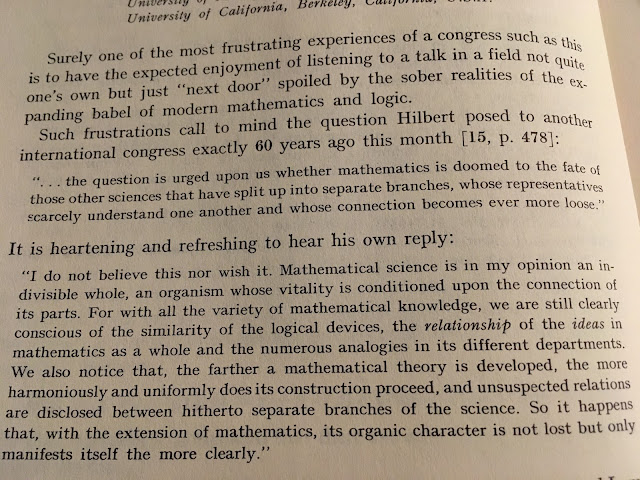
But then looking at some of the papers (the book with only invited papers has 672 pages!) I discovered something much fluffier. For me at least. Here it is:

This is J. W. Addison talking about the "expanding babel of modern mathematics and logic". And bringing Hilbert into the picture to explain that Mathematics is an indivisible whole, a connected organism that as farther as it's developed, the more we can see the harmony between its parts. 

This is pink-unicorn kind of fluffy, as far as I'm concerned!


Congresses of the Division of Logic, methodology and philosophy of science and technology


The series of Congress of Logic Methodology and Philosophy of Science (since 2019 CLMPST; Congresses for Logic, Methodology and Philosophy of Science and Technology) are the quadriennial main event of

The next one will be held in July 2023 in Buenos Aires: clmpst2023.dc.uba.ar.

But there were 16 so far. So a small project of the Women in Logic network was created to read about these congresses and describe a little how logic and logicians have been interacting since the first one, in Stanford in 1960. 

I've asked for help writing small blog posts about the congresses, but  this was  a bit late and so not all the blog posts have been written, yet. But I will copy and reproduce here the ones that have been done.

Like everything else this blog is a work in progress!

World Logic Day 2022


Since 2019 the World Logic Day is celebrated on January 14th. So it's not an old tradition, but it's one that speaks to many logicians, who would like the work they do to be better known and appreciated. So the number of seminars, small conferences and round tables have been mushrooming, which is great!

But if one has so many meetings to go to and they are not recorded, they only give you a nasty feeling of "missing out": even in the pandemic, even when the meetings are free and in principle accessible you are not able to watch them all, to take it all in--of course one needs to think how accessible things are at 5 am-- and this is bad. Or feels bad. So I thought I would like to do something different for World Logic Day 2022.

It occurred to me that instead of a meeting we should celebrate by having the launching of the Women in Logic website (https://sites.google.com/view/womeninlogic/home) this World Logic Day. We did a soft launch a week before (i.e Friday 8th) and tried to iron some of the issues, but some remained. Bugs in life and software are always there.

I'm really impressed with the website which is mostly the work of Juliet Szatko and Sandra Alves. It's beautiful, it contains lots of information about the work we've been doing in the WiL workshops, the facebook group, the twitter account, the slack channel, etc. It also points out the many projects that we are trying to do, but haven't got finished, yet. One of these small projects is described in the next blog posts, check it out!

 Many thanks for this exquisite gift, Juliet and Sandra!

Saturday, July 31, 2021

Women in Logic 2021


(This is copied from Logic ForAll, where it appeared in June 2021)

We just had another great edition of Women in Logic! Congrats to the organizers Sandra Alves, Sandra Kiefer and Ana Sokolova for a fun, challenging and  diverse meeting! Thanks also to our Invited Speakers Professors Simona Ronchi Della Rocca (Università di Torino) and Rineke Verbrugge (University of Groningen) for very inspiring talks!

This time we didn't have any incidents like last year (my write-up of the incident last year is in The curious incident of the dropped streaming, if you want to see it), but on the other hand we didn't have the streaming either and this is not so good. 

We are a small workshop, so we follow what the conference we're associating with says; and I think it's fair to say that the main issue this year has been the registration fee, which was plainly terrible. This came as a surprise to me (and, I believe, to everyone else too!). Since last year there was no registration fee for the workshop, I thought this year was going  be the same. After all,  our workshop is about logic work done by women, but it is not exactly a huge source of brownie points (or commercial value) to anyone. We help people get used to presenting their work, in other more 'hostile' environments, and I have been extremely impressed with the quality of the work the young ones do. They get some amount of mentoring on their papers and on dealing with questions, misunderstandings, etc. But for the audience, which is there to cheer them on and to learn a few things about their work, to pay 30 euros for a single day seems excessively expensive! 

After all, the silver lining of the pandemic and of the lockdowns had been the possibility,  for many, to interact with their academic heroes, to watch seminars that happened in all parts of the world, "to be" in Australia one day and the next in Colombia, while still hearing about your favorite subject. That now people insist on gatekeeping these possibilities, by making the conferences unaffordable, seems perverse.

I understand that even online conferences have costs that need to be paid, but I worry that calculations and sponsorships are following outdated models. And I believe the push to make it more accessible needs to be done by everyone in the community, not just a few. Otherwise, the prestigious conferences will carry on being unaffordable, reproducing the sins of the conventional publication model.

Thursday, March 4, 2021

Think women discrimination is a thing of the past?


Think again. This story came from one of my friends, who teaches in a local community college. My friend's daughter is a sophomore at a research university. She came up with an idea for a project in one of her neuroscience classes, developed her idea with a female friend, and they spent hours explaining the idea to the guys in the group. 

When the time came to present the project to the class, the guys questioned their ability to present and asked her to present to them first so they could be assured she was prepared and knew what she was talking about. So they  basically questioned her understanding of her own idea.

This is 2021!


Sunday, February 21, 2021

Woohoo, you and the husband are invited to a prestigious research centre?

 This is one of the histories that has a kind of happy ending, but only kind of as it seems that the scientific research center policies are still in flux. Judge for yourself.  My job is just to collect the histories, with or without name, as  people prefer it.

This story is described by an open letter in Prof Agricola's website. Professor Agricola is now President of the German Mathematics Association (DMV) and her mathematical career is not in danger.  She has the following Open Letter on her website https://www.mathematik.uni-marburg.de/~agricola/ewm-open-letter.html. I will copy  it below, but you should read it in the link, where you can find this picture.

This is Prof Agricola's son, aged three months, sleeping in the desk, while she does maths with her students. Sweet! Now you may think 2014 in Prof Agricola's letter and think this is pre-historic (some people do!), but then you should check Viviane Pons blog post from 2019 http://openpyviv.com/2019/06/08/baby-vs-cirm/, which is again a similar story.

Just one extract from Pons' blog post, that again is better written than I can provide and very much worth your time reading:

"But things changed. They changed because women and allies did not give up. There were some open letters and petitions circulating. There were some pressure being made. At a time where supporting women in math was becoming “trendy”, the policy started to be bad publicity. When CIRM would brag about their actions for supporting women (like women speaker requirements, women events, etc), there would be people to remind them of their policy. I actually know one of these women. She is a senior researcher very much involved in defending women in mathematics globally. Once at a board meeting for conference centers, she did say to them: “these things are nice of course, but what about accepting children and nursing mothers inside your facility? This is your biggest issue!”. She told me the answer she got from the CIRM at the time was along the line of “What? This has nothing to do with that! This is a legal issue we cannot do anything about”. Well, they could, and at some point, they did."

For me, my first child also went to her first conference when she was three months old.  And we cooked dinner for something like fifteen people during the meeting together. We had babysitters that we took with us to funny places, we did the old routine of "I just talked, give me the baby so that you can go talk" (when both of us were teaching), I gave talks holding on to the baby and pacing up and down to make her go back to sleep, etc. I like what I do and I wasn't going to let my children stop me from doing it.

What makes me tired is that we write letters, complain, organize petitions and we win some. But then the next week, the month or the next year, we're back at square one. It can be really tiring sometimes.

======================

Prof Ilka Agricola's letter

Dear Colleagues,

in October 2014, I was invited to attend a Meeting at CIRM in Marseille, the "Centre international de rencontres mathematiques", a conference center devoted to mathematics.

My first visit to the CIRM was as a Ph.D. student - I was single, no kids. I enjoyed my stay very much, the atmosphere for exchange and research, the beautiful surroundings. So I was looking forward for visiting the CIRM again.

However, this was not possible. My personal situation has since then changed: I am married, and we have an 11 year old son. My husband is a professor of mathematics as well, working in the same area. So in fact, I have to correct my statement: We were both invited by the organizers to be regular participants of this meeting. We therefore informed the organizers and the CIRM that we would like to bring our son. Of course, we would pay his expenses and organize a "baby sitter" for him, so that he would be occupied during the day.

Our son attended his first conference when he was 3 weeks old. Whenever possible, we leave him at home with suitable child care. But as most scientists, we do not have any relatives in the city where we were appointed professors, so it's not always possible. Our son has accompanied us to research stays all over Europe, South America and Asia. We're great at finding baby sitters wherever we go. We never had any problems, our son was welcome wherever we went. It's clear that we organized things always in such a way that he would not be a burden to organizers or other participants.

But at CIRM, all my past experience in organizing two professors and a kid was useless. I was informed sharp by the CIRM administration:

"For security reasons, children are not admitted at CIRM".

I first thought that this was a joke - our son is not dangerous, after all? But it became clear that this is dead serious. It is claimed that the insurance of CIRM "does not cover children", whatever it means. Now, being German, I have more insurances than I would ever need in my life: liability insurance, accident insurance... you name it. I offered to sign anything desired that I would cover all damages my son would cause. Nothing to do.

Instead, the CIRM administration started an outrageous game of shifting duties - weeks, almost months of e-mail exchanges followed. For example, we were told that we should try to find accomodation at the "Cite Universitaire" of the University of Marseille. Guess what they told us ? "We regret that our housing is not appropriate for families". More phone calls, more e-mails - to organizers, CIRM staff, CIRM director etc.

Finally, we gave up and cancelled our participation. And I sent a complaint to the "conseil scientifique de l'Institut National de maths du CNRS", who is part of the scientific committees supervising the CIRM. And, all of a sudden, we were offered to live at CIRM in a separate building. However, our son was still not allowed to enter the CIRM or to have breakfast and dinner there. But then we didn't want to go anymore.

Now, I understand that in the past, people may have abused of the CIRM facilities to have a nice holiday with their families - allegedly, I would think that these would have been male participants bringing their wife and children.

But our situation was different. Being both scientists in the same area, our only option for participating was to travel with our son. It is to be expected that this constellation will be even more common in the future, with more and more women in mathematics. Other situations can easily be imagined where there is just no alternative to bringing a child - a baby being breast-fed, an ill child, a single parent...

So, for me the current CIRM policy means effectively that I am being hindered to "practise" my job as scientist. And this is something that we, female mathematicians, should not accept. It is not a solution that perhaps, once in a while, one of us is successful at making enough ruckus to get an exceptional permission to bring a child - a Ph.D. student or less pushy person would not have succeeded. The policy itself NEEDS to be changed!!!

I am full professor now, I do not need to attend some singular event - if I'm not wanted, I don't go, period. But if I had never been allowed to bring my son anywhere - I would probably not be full professor today!

I firmly describe myself as being "francophile" - I attended a French Lycée in Munich, I have a French Baccalauréat C (high school degree) and even was hounored by a second price at the Concours Général des Lycées. I have some experience with French administration. Hence, this experience really makes me very sad.

I believe that French women mathematicians should urgently advocate a change in policy at CIRM. I would consider it bad style to do this as a foreigner - so, I hereby would like to encourage YOU, mathématiciennes françaises, to fight for working conditions that respect the situation of women in science! Our daily juggling of different responsibilities is already difficult, there is no need to make it harder by rules that are not up to date.

In the meantime, we were both invited to another CIRM meeting. We declined immediatly, it doesn't make sense to repeat the same story over again. Again, I would very much have liked to attend this "rencontre" and meet my colleagues. This shows that the problem will stay if nothing is being changed!

With my warmest regards from Marburg,

cordialement

Ilka Agricola

Thursday, February 18, 2021

You might think giving birth is a good reason for postponing a job interview...


 I would, really. Clearly not everyone!


Zoé Christoff had to take her case to the Netherlands Court of Human Rights! One wonders what these guys were thinking?? You can read it also on Zoe's own website https://zoechristoff.com/news/.

One would hope not to have to deal with this kind of hassle when becoming a mother!

Anyways CONGRATULATIONS to Z for the courage to take her case to court, for winning her case and,  for a lovely baby too!

(this post is another one on the series of big and not so big mistreatments of women in Academia! I am collecting the stories and sharing them here.)

Wednesday, February 10, 2021

A ton of feathers is still a ton


So I've decided to publish (anonymous) personal stories from women in our group.

 As I said on 22nd January:

I want to know about your personal stories of
discrimination/slights/sexual harassment/whatever you want to
describe. It can be anonymous (write to my gmail) or public. It can be
small or big--as the women in the documentary "Picture a Scientist" were saying, a ton of
feathers is still a ton. It can be about the work, the way you dress,
the way you smile or not. Feel free! We had an open conversation like this
in the Women in Logic meeting in Oxford 2018, but I was a bit too busy
then to do something about it. Now I can deal with it and I want to!
Help out with the stories, please--even if you told them in 2018
already. #MeToo #gendergapSTEM #willnevergetthere

Anonymous Reply

 There are dozens of things I could mention from my career
in engineering, mathematics, and logic/philosophy.  Even as I imagined
writing them down, the feeling of "Who's going to believe it" arises.
I have selected examples that are particularly objective.  Here are
the first two:
 

 Differential Treatment in Mathematics MA program

1. As a graduate student supported by a Teaching Assistantship in a
mathematics department:  our schedules were very tight, as we had
heavy teaching loads along with coursework.  Often the only time to
work on assignments was the weekend.  One professor set the due date
for Friday.  When I remarked to a male peer that the situation was
utterly impossible, he replied: "Oh, I got an extension until Monday.
Just ask for an extension."  So I did. To my surprise the professor
laughed at my request condescendingly, denying me any extension beyond
5pm Friday.  He found the situation I was in humorous.  I was stunned.
Weeks later, a woman officemate remarked to me that the professor gave
extensions to all the men who asked, but denied extensions to the
women who asked.

2.  At the end of the MA degree in that same mathematics program,
there was an oral examination consisting of being asked to present,
without notes, any of the proofs or problems from a set of ten that
were mutually agreed upon ahead of the oral exam.  I thoroughly
prepared to be able to present any of the ten problems/proofs upon
request.  The exam began, and I launched into a reply to the first
proof requested.  I hadn't written three lines on the blackboard
before one of the professors interrupted and said, "Well, we know you
can do all those - you've prepared for them."  Then he asked me
questions about topics that I hadn't prepared for, and couldn't be
expected to know.  None of the other professors intervened to get the
oral exam back to the expected protocol.  After torturing me with
questions I hadn't prepared for for an hour, I was asked to leave the
room so the examiners could discuss my performance.  After waiting
some time in humiliation, my advisor came out and said  "They passed
you.  Your written work [over the course of the MA program] was much
better than your oral performance [on the MA oral examination that
day]."   There was never any recognition that the exam protocol had
been violated to practically guarantee that result.
    Later, I ran into a male MA candidate who had also recently had
his oral examination.  He commented about the experience, saying
something to the effect of "That was a joke."  "How do you mean?" I
asked, hoping to commiserate.  I was stunned by his answer.  "Well,
you must know.  They don't ask you any math questions, they just chat
with you, like, they asked me, 'How was your summer?  What are you
doing next year?' "


Saturday, January 23, 2021

``Picture a Scientist"

``Picture a Scientist" is a new documentary  about women scientists and how they just want to do their work and how people (mostly white old men) don't let them. The trailer is in https://www.pictureascientist.com/media. there was an event to discuss the film where I learned about the reports


The links:

[1983 CSAIL Report] “Barriers to Equality in Academia: Women in Computer Science at MIT”:   https://www.dropbox.com/s/eherc37esqabj0i/MIT-Barriers-Report.pdf?dl=0

[1999 MIT Report] “A Study on the Status of Women Faculty in Science at MIT”: http://web.mit.edu/fnl/women/women.html

[Fall 2019 CSAIL Report] Diversity, Equity, and Inclusion in the CSAIL Community: https://drive.google.com/file/d/1jkh_-TN42PtmUqqqxoQfaMKjppL3Jq6Y/view?usp=sharing

The 2018 report by the National Sciences Foundation that Nancy Hopkins refers to: 2018 Sexual Harassment of Women: Climate, Culture, and Consequences in Academic Sciences, Engineering, and Medicine: https://www.nap.edu/catalog/24994/sexual-harassment-of-women-climate-culture-and-consequences-in-academic


I was very struck by something I think Karen Sollins (one of the 1983 original document proposers) said. Paraphrasing slightly "we were lucky that there were enough of  us  so that we could anonymize the cases and the people involved". She seemed to say that to describe issues of  race and sexual orientation would've been even harder to do, as the numbers are even smaller.